What are the types of flow meters? How to choose in water treatment [Basic Knowledge]
Principles and strengths and weaknesses of flow meters such as electromagnetic, ultrasonic, vortex, and positive displacement types will be explained. We will also discuss important points to consider when measuring in drainage channels and chemical injection.
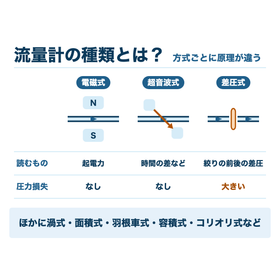
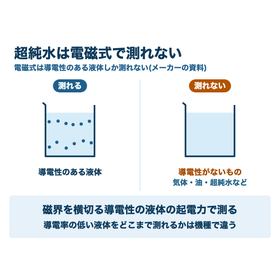
A flow meter is an instrument used to measure the amount of liquid flowing through pipes or channels. In industrial water treatment, it is used to monitor the volume of wastewater and the amount of chemical injection. The principles vary by type, and the liquids that can be measured and the installation conditions also change. ■ What are the methods for measuring inside a pipe? 1. Electromagnetic: Determines flow velocity from the electromotive force generated when a conductive liquid crosses a magnetic field. 2. Ultrasonic: Determines flow velocity from the time difference of ultrasonic waves or the frequency shift due to the Doppler effect. 3. Vortex: Determines flow velocity from the frequency of the Kármán vortex formed behind a vortex generator. 4. Differential pressure: Determines flow rate from the differential pressure generated before and after a constriction. 5. Area: Reads flow rate from the position of a float that rises within a tapered pipe. 6. Turbine: Determines flow rate from the rotation of a turbine. All of these methods are used as flow meters for wastewater, and there are installation considerations based on each principle. ■ Volumetric method using a measuring bucket The volumetric method uses the space between a rotor and a case like a measuring bucket, counting the volume based on the number of times liquid is dispensed. It is suitable for high-viscosity liquids and does not require straight pipe sections before and after. Please feel free to consult us first.
- Company:トリイ
- Price:Other